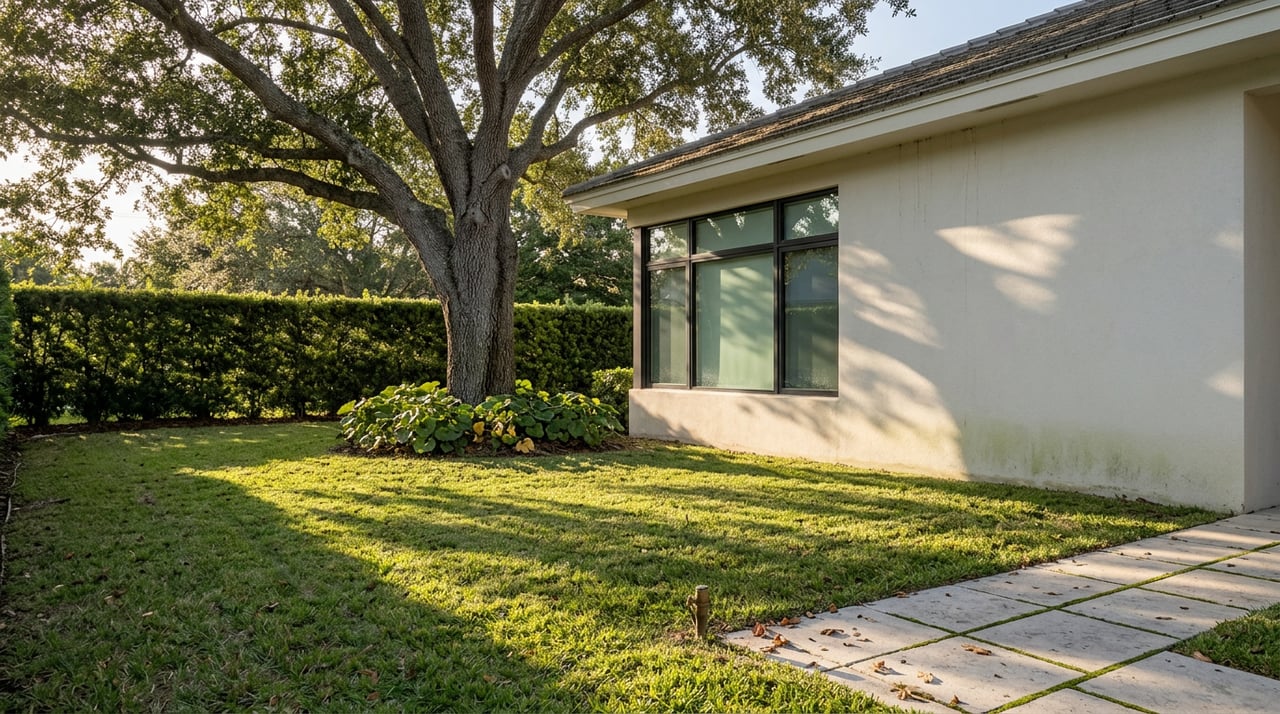
A buyer touring Pinecrest for the first time usually makes the same mistake twice. First, they assume a bigger, nicer house should cost more per square foot than a smaller, dated one. Then they assume that when two homes list at nearly the same price, the newer one is the better deal. Neither assumption holds here, and the reason has nothing to do with taste or timing. It has to do with what a Pinecrest home actually is: a structure sitting on top of the real asset, which is the land underneath it.
That distinction sounds academic until you start comparing listings. Once you see it, you can't unsee it, and it changes how you should be reading every price you find.
The Number That Contradicts Itself
Pull the current MLS snapshot for Pinecrest single-family homes and you run into a strange split almost immediately. As of a live single-family listings pull taken July 21, 2026, active asking prices in the village ranged from $1.3 million to $22.5 million, with a median of $4.7 million and an average of $6.1 million.
A $1.4 million gap between the median and the average is not a rounding issue. It means a small cluster of estate-level listings at the top of the market is dragging the average well above what a typical Pinecrest home is actually asking. If you only quote the average, you're describing the top of the market to someone shopping in the middle of it.
This is also why three different portals can hand you three different "Pinecrest median prices" in the same season and all be technically correct. Realtor.com's snapshot put the median around $3.79 million in December 2025. Redfin's own portal figure landed closer to $4.225 million in January 2026. Closed sales tracked by Redfin showed a median of $3.4 million for homes that actually sold in November 2025, up 39.3% from the year before. None of these numbers are wrong. They're measuring different slices of a market that isn't one market at all.
Why $/Square Foot Stops Working Here
Most buyers use price per square foot as a sanity check. In Pinecrest, that check breaks down faster than almost anywhere else in Miami-Dade, because the number is blending two entirely different products.
| What you're looking at | Typical price per square foot (active listings, July 2026) | What the number is really pricing |
|---|---|---|
| Village-wide median | Roughly $987/sqft | A blend of 1960s ranch homes and brand-new construction, averaged together |
| Older homes on strong, larger lots | Below the $987 median | Mostly land value, with the structure discounted for age and condition |
| New construction | Roughly double the village median | Land value plus a fully rebuilt structure |
That spread means the same $987 figure can describe a dated home on excellent dirt and a brand-new build on an average lot, priced almost identically per square foot for completely different reasons. Comparing two listings on $/sqft alone tells you almost nothing until you know which side of that split each one sits on.
The Reason the Floor Doesn't Move
The mechanism behind all of this is zoning, not sentiment. Pinecrest's typical active lot right now runs about 0.85 acres, and Village code does not allow those parcels to be subdivided. That single rule means the supply of buildable Pinecrest land is fixed in a way the supply of Pinecrest houses is not. A structure can be renovated, expanded, or torn down and rebuilt. The lot underneath it cannot be split into two smaller, more affordable parcels, no matter how much demand shows up for entry-level inventory.
That's the quiet reason a dated home on 0.85 acres can hold its price even while it sits on the market longer than it used to. The buyer isn't really negotiating over the kitchen or the roof. They're negotiating over one of a fixed number of acre-plus parcels the Village will never allow to multiply.
You can see this pattern showing up in redevelopment activity across the community, where older homes built in the 1960s on one-acre lots are increasingly bought specifically to be replaced, not renovated. The buyer isn't paying for the 1960s structure. They're paying admission to a lot they can build on from scratch.
Who's Actually Buying On These Terms
Cash buyers are unusually common in Pinecrest, and they gravitate specifically toward large lots and teardown candidates. That's not a coincidence. A buyer planning to demolish and rebuild has no reason to pay a premium for someone else's finishes, and every reason to focus their offer on the one thing they can't create more of: the parcel itself. Some buyers are purchasing raw acreage in the $3 million to $3.5 million range specifically to build custom homes or to acquire brand-new construction outright, bypassing the older housing stock entirely.
The demand side of this tells the same story from a different angle. A recurring pattern in 2026 has been families leaving smaller homes in Coral Gables and moving into Pinecrest or Palmetto Bay in search of more rooms, more land, and more yard space. They're not just buying more square footage. They're buying out of a market where lots can theoretically still be divided and into one where they structurally cannot be, which is part of what keeps Pinecrest's floor from softening even as its pace slows.
A Slower Clock, Not a Falling Floor
Buyers touring Pinecrest today do have more room to be selective than they did a few years ago. Days on market have stretched into the 96 to 116 day range in recent reporting, with Redfin's closed-sales data showing homes taking 134 days on average as of November 2025, up from 121 days the year before. Some segments have carried eight to ten months of inventory at points in 2025.
That slower pace is real, and it means buyers can tour multiple homes, negotiate on inspections and repairs, and take their time in a way that would have been unthinkable during the tightest years of the post-2020 market. But a slower clock on the structure side doesn't translate into a falling floor on the land side. The zoning constraint that keeps lots from multiplying doesn't loosen just because buyers are taking longer to decide. Inventory can build. Days on market can climb. The number of buildable acre-plus parcels in the Village stays exactly where it was.
What You're Actually Buying Into
Part of what keeps that land in demand is the community sitting on top of it. Pinecrest Gardens, the village's botanical garden and cultural park, occupies the former grounds of Parrot Jungle, the Miami attraction that opened in 1936 and today holds a spot on the National Register of Historic Places. Farmers markets, concerts, and festivals run there throughout the year, set inside a canopy of mature oak and banyan trees that took decades to grow and can't be replicated on a new lot somewhere else.
The area seeing the fastest activity right now is often described as North Pinecrest, closer to the commute corridors into Coral Gables. That pocket's advantage isn't a different zoning rule. It's proximity, the same oversized lots and tree canopy paired with an easier commute, which is exactly the kind of premium that shows up in price without ever showing up in a square-footage comparison.
A Few Questions Worth Asking Before You Tour
If I want a move-in ready home, does the land-value logic still apply to me? Yes, even if you have no interest in tearing anything down. Because land value anchors the floor under every Pinecrest listing, a fully renovated home on an average lot can price similarly to a dated home on an exceptional one. Knowing which value driver you're paying for helps you negotiate on the right thing, whether that's finishes or the parcel itself.
Is Pinecrest currently a buyer's market or a seller's market? The honest answer is that it depends on the segment. Longer days on market and rising inventory have given buyers more negotiating room than they've had in years, particularly on homes priced to last year's comps. But land scarcity means well-priced homes on strong lots, especially ones positioned for redevelopment, still draw serious, often cash-backed interest.
Bring Us the Lot You're Actually Comparing
Reading a Pinecrest listing correctly means separating what you're paying for the dirt from what you're paying for the structure sitting on it, and that split isn't something a portal search filter can do for you. Roberto Azua and the Azua Nardon Team have spent decades reading Miami-Dade lots block by block, from Pinecrest's zoning-protected acreage to the family neighborhoods around it. If you're comparing homes here and the price-per-square-foot math isn't adding up, reach out for your free home valuation and we'll walk through exactly what a specific lot is worth in today's market, not just what the average says it should be.