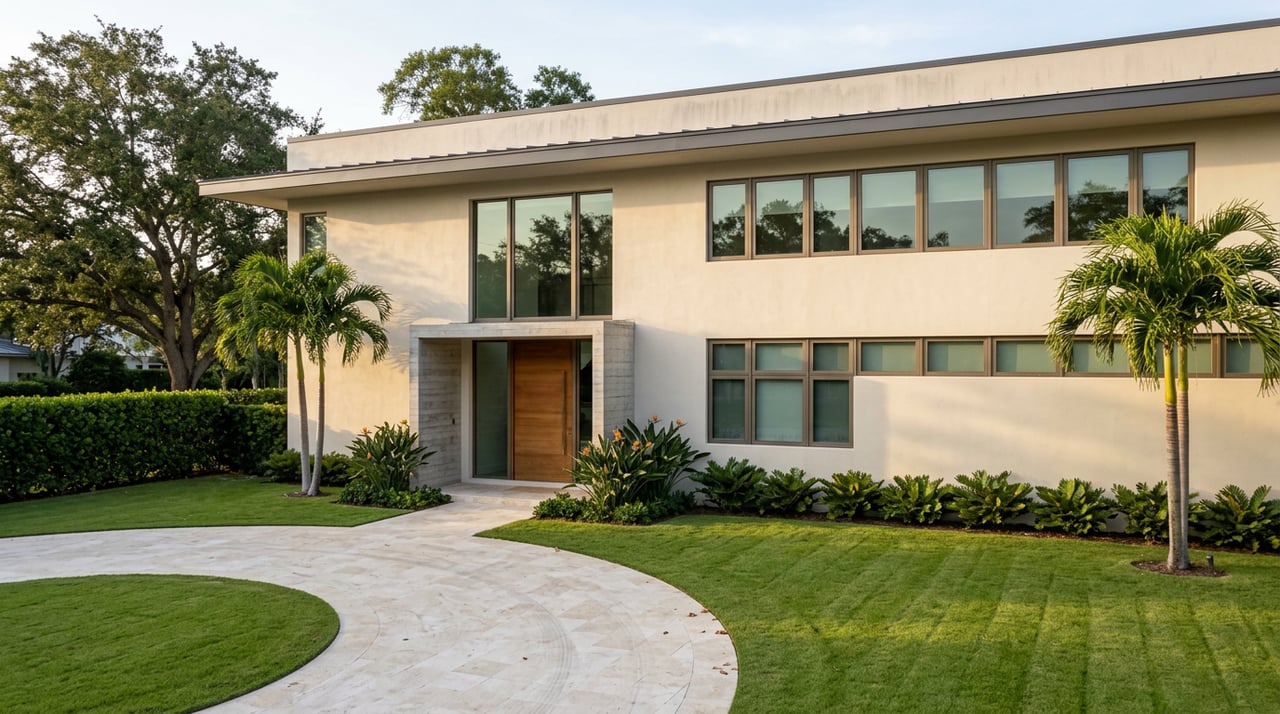
A four-bedroom, 4,000-square-foot estate on SW 74th Avenue in Palmetto Bay sold in three days this year at its full asking price of $2,485,000. No formal price reduction ever posted to the MLS, no visible retreat from the seller's original ask.
Meanwhile, over the same six-month stretch, just over half of everything that sold for under $1 million in the village needed at least one price cut before a buyer signed. Same village. Same season. Same MLS. Completely different negotiating reality depending on which side of an invisible line the home sits on.
That split is the actual story in Palmetto Bay right now, and it matters more than the median price anyone quotes you. If you're comparing this village to Pinecrest, or trying to figure out what your money actually buys here, the price band your home falls into determines your leverage far more than the overall temperature of the market.
What Six Months of Closed Sales Actually Show
Pulling from 134 closed sales tracked by the Miami Association of REALTORS over the trailing 180 days, the pattern by price tier looks like this:
| Price Band | Share of Closed Activity | Needed a Price Cut | Days on Market |
|---|---|---|---|
| Under $1M | about 41% of the 134 sales | 51% | not broken out separately |
| $1M – $2M | 69 of 134 sales (more than half) | 43% | 39 days median, 79 days average |
| $2M – $3M | 6 sales | 0% (no MLS price reductions) | 26 days median |
| $3M+ | 4 sales | small sample | 46 days average, excluding one outlier |
Read that table one more time. The cheapest homes in the village are the ones most likely to sit and get marked down. The most expensive ones close clean.
Why the Top Tier Never Blinks
The mechanism isn't that wealthy buyers are less price-sensitive. It's that inventory at the top of the Palmetto Bay market is thin and each home is different enough from the next one that buyers can't cross-shop it against a close substitute.
New construction on Old Cutler Road is currently trading between $799 and $934 per square foot, with two recently completed homes closing at $5.8 million and $6.2 million and active listings running as high as $9,495,000. On the waterfront side, two Paradise Point listings were pending this year at $3,499,000 and $6,500,000, both above $1,100 per square foot. There isn't a second identical lot on Old Cutler Road to point to during negotiation. There isn't a comparable Paradise Point listing sitting fifty feet away at a lower price. When a buyer wants that specific stretch of road or that specific water access, the seller holds the number.
That said, "zero price reductions" isn't the same as "zero negotiation." The average sale-to-list ratio in the $2M to $3M band still landed at 95.2 percent, which means buyers were shaving dollars off at the closing table even when the public listing never showed a markdown. The seller never had to blink in public. That's a different kind of leverage than getting the full number, and it's worth knowing the difference before you assume a listing at that tier is untouchable.
The Middle Band Is Where Pricing Gets Tested
The $1 million to $2 million range is where most of Palmetto Bay actually lives. Sixty-nine of the last 134 closed sales happened here, more than half of all activity in the village.
This band has real inventory depth, which means buyers can and do compare. A four-bedroom on SW 79th Court listed at $1,400,000 and sold for $1,464,000, or 104.6 percent of asking, in eight days. That's a home priced to what the market would bear, and competition took care of the rest.
But look at the gap between the median and the average days on market in this same band: 39 days median, 79 days average. That's not noise. It means a cluster of homes moved fast because they were priced correctly, and another cluster sat for months because they weren't, dragging the average up while the median stayed reasonable. The homes stuck at 79-plus days generally aren't bad houses. They're houses where the number on the sign hasn't caught up to what buyers are actually willing to pay for that layout, that lot, that street.
The $1 million to $2 million tier doesn't punish sellers for asking a fair price. It punishes them for guessing.
The Pinecrest Comparison Everyone's Already Making
If you've spent any time searching for a home just north of Palmetto Bay, you've already run the Pinecrest numbers. Palmetto Bay is currently running about 30 to 40 percent cheaper per square foot than Pinecrest for comparable properties, with recent figures putting Palmetto Bay around $616 per square foot against $900 or more in Pinecrest.
That gap is real, and it's the reason a lot of buyers who got priced out of Pinecrest end up looking here first. But the discount doesn't mean pricing works the same way in both places. A buyer who anchors to Pinecrest expectations and assumes Palmetto Bay homes will simply sell at a flat discount off whatever number they had in mind misses the fact that the band dynamics inside Palmetto Bay are just as important as the village-to-village gap. A $1.6 million home here isn't competing against Pinecrest inventory. It's competing against the 69 homes that closed in its own band over the last six months, and buyers in that band are shopping closely enough to catch a home that's priced ten or twenty thousand dollars out of step with the street.
Before You Set a Number
A few things worth thinking through before you price a home in Palmetto Bay, whether you're the one selling or the one making an offer:
- Know which band your home falls into and pull comps from that band specifically, not a village-wide median that blends a $700,000 ranch house with a Paradise Point waterfront estate.
- If you're above $2 million, understand that thin inventory gives you room to hold a number, but the sale-to-list data suggests buyers still expect some room at the closing table even without a public reduction.
- If you're in the $1 million to $2 million range, treat the first two weeks on market as the real test. Homes here either move quickly at close to ask or drift toward that 79-day average, and the difference is almost always the opening number.
- If you're under $1 million, budget for the likelihood that the home will need a price adjustment. That's the norm in this band right now, not a sign something is wrong with the property.
A Couple of Straight Answers
Does "zero price reductions" mean the $2M-plus tier never negotiates? Not quite. It means sellers in that band rarely make a public markdown before closing. The final sale price still came in at an average of 95.2 percent of the original list, so negotiation happens, it just happens quietly rather than through a visible price cut.
Is the sub-$1 million tier just a weaker market? Not necessarily. It reflects more competition and more substitutable inventory at that price point, which gives buyers more leverage to ask for an adjustment. It's a function of how many similar homes are on the market at once, not a signal that anything is wrong with those properties.
What if my home sits right at the edge of a band, like $1.9 million or $2.1 million? Where you land can shift which pool of comps and which set of buyer expectations you're competing against. That's exactly the kind of judgment call worth a conversation before you set a list price rather than after.
If you're weighing a move into Palmetto Bay, comparing it against Pinecrest, or trying to figure out where your own home falls in this picture, the Azua Nardon Team has been reading South Florida price data like this for three decades and can walk through what your specific street and price point actually look like right now. Get your free home valuation and we'll show you exactly which band you're in and what that means for your number.