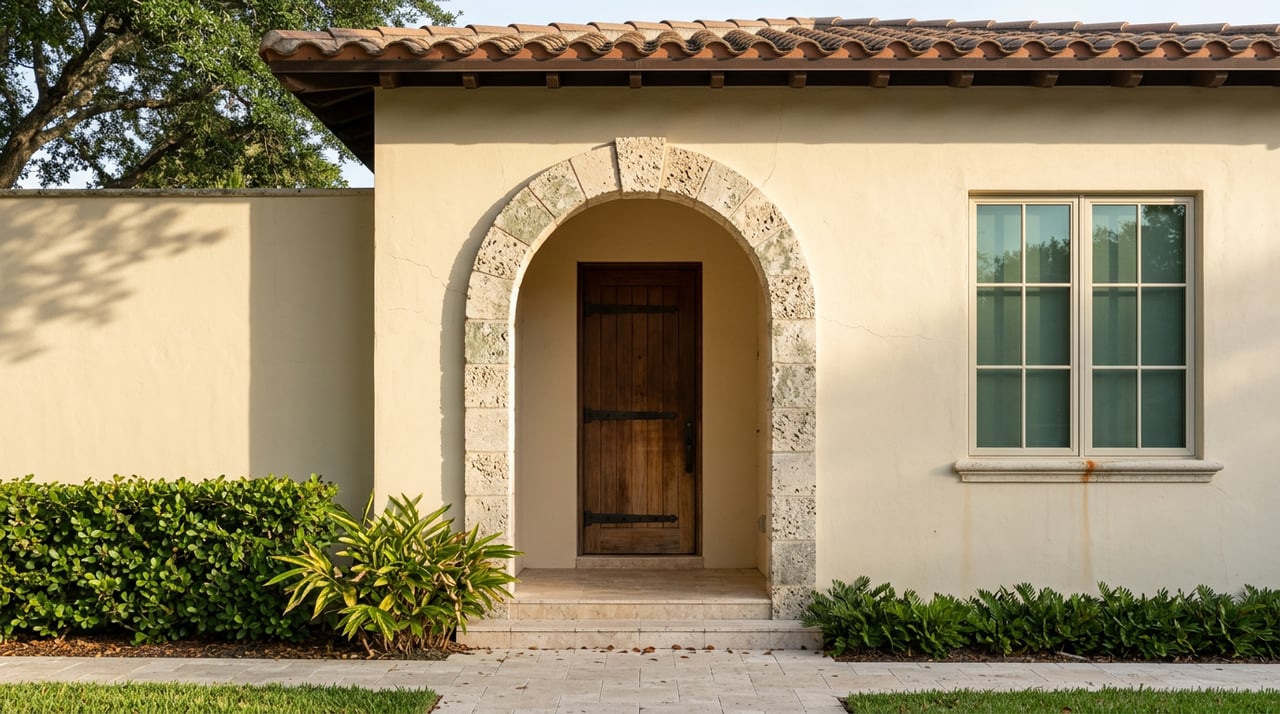
A buyer walks a Country Club section house with her architect, mentally pricing out a new fence, a repainted facade, and a swapped-out front door. Somewhere in her research, United Architects says Florida's 2026 legislature exempted residential work under $7,500 from needing a building permit at all. She does the math and figures she just cleared three items off her punch list before closing. She hasn't. In Coral Gables, none of those three items ever needed a building permit to be the bottleneck. The building permit was never the problem.
The real gate in this city sits one step earlier, and it doesn't care what the job costs.
What the exemption actually covers
House Bill 803 took effect in Florida on July 1, 2026, and it does what it says: certain residential work valued under $7,500 no longer requires a state building permit. But the exemption carves out the trades that matter most in a renovation. Electrical, plumbing, structural, mechanical, and gas work are excluded regardless of cost, and the exemption doesn't apply at all to property in a flood hazard area. Even where it does apply, the owner or contractor still has to submit a written request. It isn't automatic.
None of that touches Coral Gables' own design review requirement. Exterior work on a property still needs its usual approval no matter how small the invoice is. A $600 paint job on a designated historic house still needs a Certificate of Appropriateness. A new fence on a non-historic lot still needs Board of Architects sign-off. The state exemption is a genuine convenience for interior cosmetic work like flooring or cabinetry on a non-designated house. Outside that narrow lane, it changes nothing about your timeline.
The board that meets every week
Coral Gables runs one of the more active design review calendars in South Florida. The Board of Architects meets every Thursday at 8:30 a.m., and it reviews nearly any exterior change on a non-historic property: new construction, additions, roofing, window replacement, paint color, fences and gates, driveway and paver work, accessory structures, even mailbox placement and material. Interior renovations that leave the exterior envelope alone generally skip the board and go straight to plan check.
Submittals are due roughly three weeks ahead of the meeting a project is targeting, and the packet has to include drawings, material samples, color samples, and a narrative explaining how the design conforms to the city's Mediterranean Revival standard. Review typically runs three to eight weeks per cycle, and most projects need two to four cycles before they clear. Common revision requests involve window proportions, roofline material, ornamentation the board considers excessive, and paint colors outside the approved palette. Only after final approval does the project move to plan check for structural, electrical, plumbing, and life safety compliance, which adds another six to twelve weeks on its own.
Add it up and a straightforward exterior project can spend two to three months in design review before plan check even starts, and a project that needs revisions can run considerably longer.
One real agenda, sixteen applications
It helps to see what actually crosses this board in a given week rather than take the process on faith. At a July 31 meeting covered by the Coral Gables Gazette, the Board of Architects worked through a slate of sixteen design review applications in a single sitting, ranging from modest upgrades to full new construction. Among the items were proposals for new two-story single-family homes at 35 Palermo Avenue, 931 Roderigo Avenue, 524 Mendoza Avenue, 2511 San Domingo Street, and 1915 Country Club Prado, with design influences described as everything from "Old Florida" to contemporary. The mix on that single agenda is the point: this is a routine week, not an outlier one, and the same volume of applications moves through the board every Thursday.
The board doesn't have the power to reject an application outright. What it can do is withhold approval and request changes, cycle after cycle, until the design fits. That's a meaningful distinction for a buyer budgeting a renovation. There's no hard stop where the city tells you no and you move on. There's only a queue that keeps running until your plans match what the board will sign.
Much of the city's new construction still reads Mediterranean even when a buyer's brief calls for something more contemporary.
If your house is designated, there's a second clock
Everything above assumes a non-historic property. If the house you're buying is listed on the Coral Gables Register of Historic Places, individually or as a contributor to a historic district, exterior work runs through a separate process: a Certificate of Appropriateness reviewed by the city's Historical Resources staff or the Historic Preservation Board, which meets on its own monthly schedule and requires submittal well in advance.
A straightforward repair in kind can clear staff review quickly.
The tax break nobody budgets for
Here's the piece that tends to get lost under the frustration of the review calendar: owners of a locally designated property can apply for a real financial offset. Under Florida's historic ad valorem tax exemption program, available jointly through Miami-Dade County and the City of Coral Gables, an approved rehabilitation freezes the assessed value attributable to the improvement, not the whole property, at its pre-renovation level for ten years.
The application runs in two parts. Part I is filed before construction begins and requires a Preconstruction Review along with before-and-after photo documentation. Part II is filed after completion. The process runs through both the city's Historical Resources Department and the county's historic preservation office, which adds real lead time of its own. For a substantial restoration using historically appropriate materials, the exemption can meaningfully offset the premium those materials carry over standard modern substitutes.
Coral Gables' Preserving Our Past guide says designation itself does not raise your property taxes. The benefit only applies to the value created by an approved rehabilitation, and it only helps owners who go through the process correctly from the start.
Before you write the offer
The sequencing that works is the opposite of how most buyers approach a fixer: confirm the property's historic status, walk the scope with an architect who has been in front of this specific board before, and get a realistic read on how many review cycles the plan is likely to need, all before the offer goes in. A renovation budget built around the building permit fee alone is missing the actual cost center. The design review calendar is the cost center, in time if not in dollars, and it runs on its own schedule regardless of what the state legislature exempts.
A few questions worth asking early
Does the $7,500 exemption mean small exterior jobs skip the Board of Architects? No. The exemption is a state building-permit threshold. It has no effect on Coral Gables' design review requirement, and exterior work on a designated property still needs a Certificate of Appropriateness regardless of the dollar amount.
How long should I actually plan for design review before I can pull a permit? For a non-historic exterior project, plan on multiple review cycles of three to eight weeks each, commonly two to four cycles, followed by six to twelve weeks of plan check once the board signs off. Historic properties add the Certificate of Appropriateness step on its own separate monthly schedule.
How do I find out if a specific house is historically designated before I close? Ask the city's Historical Resources Department directly and request any Certificate of Appropriateness records or board minutes tied to the address. Don't assume age alone settles it. Not every older house in the city carries the same designation or the same review requirements.
If you're weighing a Coral Gables property with renovation plans already in mind, it's worth walking the scope with someone who knows which board it's headed to and what that board tends to ask for. Roberto Azua and the team have spent three decades in these neighborhoods and can help you price the timeline honestly before you write the offer. Get your free home valuation and let's talk through what the property you're considering will actually take.
This article is general information, not legal, tax or financial advice. Consult a qualified professional about your situation.